Owning a pool table comes with a learning curve most people don't expect. Between moves, installations, refelting, and repairs, there's a lot more happening beneath that green (or blue, or burgundy) surface than most homeowners realize. This guide walks through every major pool table service, what it involves, and how to know which one your table actually needs.
Whether you're relocating to a new home, refreshing worn cloth, or trying to figure out why your table suddenly plays a little crooked, this is meant to be a plain-language resource.
Why Pool Tables Aren't Like Other Furniture
A pool table isn't a single piece of furniture. It's an assembly of separate components (frame, legs, slate, rails, cloth, and pockets) that all have to work together with precision. The slate bed alone typically comes in three separate pieces that must be leveled and seamed to a hair's width of accuracy. That's part of why moving, setting up, or repairing a table isn't something that maps cleanly onto general handyman or furniture-moving work.
Because of this, most pool table services fall into a handful of categories: moving, setup, refelting (recovering), and repairs. Each has its own process, timeline, and price considerations. Here's how they break down.
Pool Table Moving
Pool table moving is the service most people search for first, and it's usually the most involved. A table can't simply be carried from one room to the next; it has to be broken down into its component parts, transported safely, and rebuilt from scratch at the new location.
What the process looks like:
Teardown – The rails come off, the cloth is carefully removed or protected (depending on whether it's being reused), and the slate is separated into its individual pieces.
Transport – Each slate piece is wrapped and padded to prevent chips or cracks, since slate is heavy but surprisingly fragile at the edges. Everything is loaded securely for the drive.
Reassembly – At the new location, the frame goes back together, the slate is reset and releveled, the cloth is reattached, and the rails are remounted and squared.
A straightforward move typically takes 3–4 hours from start to finish, factoring in teardown, drive time, and reassembly, though that window shifts depending on distance, staircases, and the type of table involved. Tables that are already broken down, tournament-style tables with more hardware, or moves involving multiple flights of stairs will generally run longer.
One detail worth knowing: your table doesn't need new cloth just because it's being moved. If the felt is in good shape, it can typically be removed carefully and reused at the new location. If it's already showing wear, a move is a convenient time to combine it with a refelt, since the table is already partially disassembled.
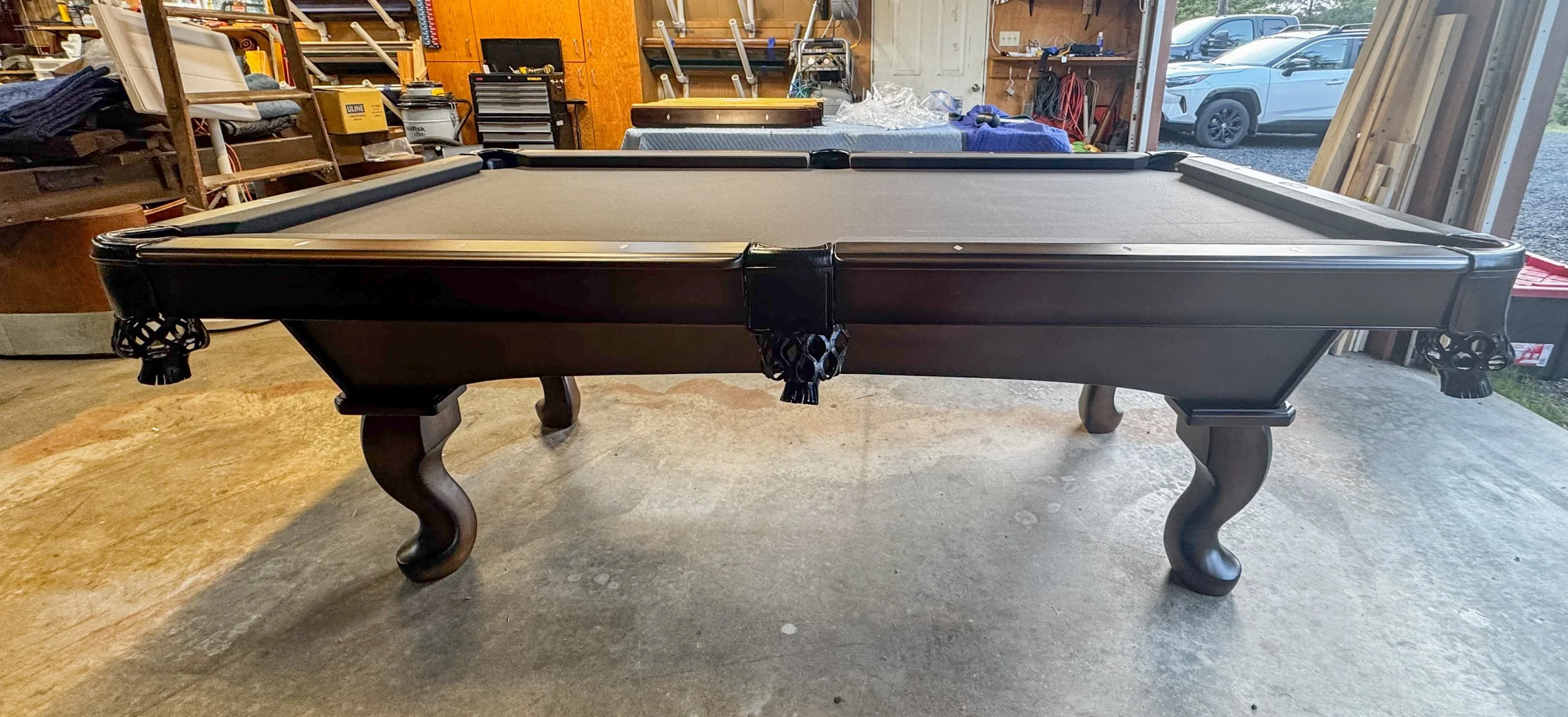
Pool Table Setup and Installation
Setup (or an installation) is a different scenario than moving. This is the service you need when the table is already at your home. Maybe it's new, maybe it's inherited, maybe it's been sitting disassembled in a garage and it simply needs to be built and made playable.
What's involved in a setup:
Assembling the frame and legs
Leveling each piece of slate individually so the seams sit flush and the surface reads true across its entire length
Attaching the cloth over the slate
Mounting and squaring the rails
Final leveling checks to confirm the table plays consistently in every direction
Setups typically run 90 minutes to 3 hours, with the biggest time variable being the table itself. A standard home furniture-style table is generally quicker to set up than a tournament-style table, which has more hardware and stricter tolerances. Stairs and tight access points also add time.
Setup is also a natural point to swap in new cloth if the existing felt is worn, since the table is already fully apart. Doing it during setup avoids paying for a separate standalone visit later.
Pool Table Refelting (Recovering)
This is one of the most searched pool table services, and it goes by two names: refelting and recovering. The process involves removing the old cloth from both the bed and the rails and replacing it with new fabric.
The refelting process:
Rails are removed from the table
Old cloth is stripped from the rails and the slate bed
New cloth is cut and stretched tight across the bed
Cloth is applied to the rails
Rails are reattached and squared back onto the table
Cloth comes in a wide range of colors, weights, and grades, which means the cost of a refelt can vary quite a bit depending on what you choose. It's worth taking time to understand cloth options before committing, since higher-grade cloth tends to hold up better under regular play and keeps its speed and color longer.
Most refelting jobs also involve some minor slate adjustment or leveling as part of the process, since the rails are already off. If the slate needs a full reset (not just a touch-up) that typically adds to the scope of the job.
How do you know when it's time to refelt? A few common signs:
The cloth looks faded, fuzzy, or worn thin in high-traffic zones (the head spot, break area, and rail edges wear fastest)
Balls roll unevenly or seem to drag in certain spots
The color has shifted significantly from age or sun exposure
You're changing the look of a room and want a different color
Refelting is also a common add-on during a move or setup, since the table is already partially disassembled and it saves the cost of a separate visit later.
Pool Table Repairs
Not every issue requires a full recover or a move. Repairs cover everything from small fixes to more involved structural work, and they're often the least understood category of pool table service because the range is so wide.
Common repair categories include:
Cushion and bumper replacement. The rubber cushions lining the rails lose their bounce over time, which changes how the ball rebounds off the rail. Replacing them restores consistent play. This is also when pocket size is sometimes adjusted; standard corner pockets run about 5 inches wide, while tournament and league-style tables are typically tighter, around 4.5 inches or less. Tightening pockets is a popular request from players looking to sharpen their game, since even a half-inch difference meaningfully changes which shots go in.
Slate leveling and repair. An uneven roll on a table doesn't always indicate a need for slate replacement. It’s often just a leveling issue that can be resolved without removing the cloth.
Pocket and hardware repair. Leather or plastic pockets wear out, staples pull loose, and rail hardware loosens with age and use. These are usually straightforward fixes on their own.
Structural repairs. Cracked slate, damaged frames, or old tables that have shifted out of square fall into more involved repair work, and the approach depends heavily on the table's age, construction, and materials.
If cushions are being replaced, keep in mind that fresh cloth generally isn't applied over rails that are otherwise in poor shape. The rail work needs to happen first, or the new cloth won't have anything sound to sit on.
Understanding Your Table Type
One thing that surprises a lot of table owners: not all pool tables are built the same way, and the type of table you have affects the timeline and approach for nearly every service above.
Furniture-style tables are the most common home table, with leather or plastic pockets, moderate hardware, generally the quickest to move, set up, or recover.
Tournament-style tables are built for durability and consistent play, with more components and tighter tolerances. They take longer to service properly and are common in serious home setups or league play.
Coin-operated tables ("bar boxes") use a single piece of slate rather than three, have a ball return system, and move as one unit rather than breaking down into parts, which also means they generally can't go up or down stairs.
Antique tables (roughly pre-1950) were built differently than modern tables and often come with their own quirks that require extra care and experience to service properly.
Knowing which category your table falls into is genuinely useful before requesting a quote, since it directly affects both time and scope.
What to Expect When You Book a Service
Every table and every home is a little different, but a few things are consistent across most jobs:
Access matters. Stairs, tight hallways, and long carries from the driveway all affect time and difficulty.
Most jobs fall within a standard scope. The majority of moves, setups, and refelts fall into predictable time and cost ranges; it's the exceptions (tournament tables, structural repairs, difficult access) that shift things.
Combining services saves time and money. If your table needs more than one thing, say, a move and a refelt, having it all done in the same visit is almost always more efficient than scheduling separate appointments.
Transparency matters. A trustworthy provider should be willing to walk you through pricing considerations and answer questions before you commit, not just quote a number and move on.
Where We Work
We're based out of the Portland Metro area and spend most of our time on the road, servicing tables throughout the Pacific Northwest. Our core coverage includes Portland, OR,Vancouver, WA, and Salem, OR, with regular trips extending into Southern Oregon, including Ashland,Grants Pass, and Medford, as well as up into Western Washington. Wherever your table is, there's a good chance we can make it work.
Get in Touch
If you're not sure which service your table needs, that's a completely normal starting point; most people aren't. The most reliable way to get a clear answer is to describe what's going on and let a technician help you figure out the right next step.
Call 360-686-9059 or reach out through our contact page to get started.
Frequently Asked Questions
What's the difference between refelting and recovering a pool table?
Nothing, they're the same service. "Refelting" and "recovering" both refer to replacing the cloth on the bed and rails of the table.
Do I need to replace the cloth every time I move my table?
No. If your current cloth is in good condition, it can usually be removed carefully and reinstalled at the new location. Refelting is only necessary if the cloth is worn, damaged, or you want to change the color.
How long does a typical pool table service take?
Moves generally take 3–4 hours start to finish. Setups and refelts usually run 90 minutes to 3 hours. Tournament-style tables, difficult access, or additional repair work can extend any of these timelines.
Can any table be moved up or down stairs?
Most furniture-style and tournament tables can be carried in pieces up or down stairs. Coin-operated (bar box) tables move as a single unit and generally cannot.
What size cloth do I need for a refelt?
It depends on your table size. Most residential tables are 7, 8, oversized 8, or 9 feet, measured by the distance between the cushion noses. If you're not sure what size you have, a technician can walk you through how to measure it.
Is it possible to just repair cushions without replacing the cloth?
Yes, cushion or bumper replacement can be done on its own. That said, fresh cloth typically isn't applied over rails that are otherwise in poor condition, so if the rails need work, that gets addressed first.